China Top Tapered Roller Bearing Manufacturers?
China Top Tapered Roller Bearing Manufacturers?
China’s bearing industry has become an important global manufacturing base. China Bearing Industry Association statistics show the sector has substantial production capacity, broad supplier coverage, and strong export participation. However, capacity alone does not prove dependable quality. Buyers must examine process control, steel traceability, heat-treatment records, and real test results.
Recent findings from the MarketsandMarkets Bearings Market report identify automotive and industrial machinery as major demand sectors. Grand View Research also reports that Asia-Pacific remains a leading regional market for roller bearings. These trends support China’s growing role in Tapered Roller Bearing supply. Yet, market growth can hide uneven performance. Some factories offer excellent engineering support, while others compete mainly through low prices.
The practical question is not simply, “Who is the largest manufacturer?” It is, “Who can deliver stable performance under real loads?” Tedric A. Harris, a respected bearing analyst, wrote, “The bearing is the most highly stressed component in a machine.” His statement remains highly relevant. A poorly controlled raceway can create noise, heat, vibration, and early failure. Small defects matter.
This guide reviews leading Chinese manufacturers through measurable criteria. These include ISO certification, IATF 16949 capability, production scale, dimensional control, laboratory testing, customization, and after-sales support. Sample inspection is also important. A polished factory tour is not enough. No ranking is perfect. Supplier claims still require independent verification, especially for critical applications, heavy trucks, gearboxes, and mining equipment.
Tapered Roller Bearings: ISO 355 Sizes, Load Ratings, and Contact Angles
China Top Tapered Roller Bearing Manufacturers?
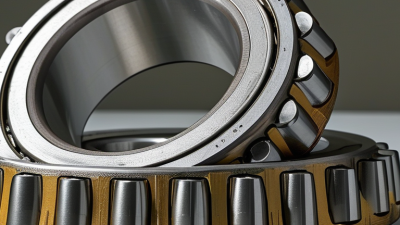
ISO 355 defines standardized inch and metric dimensions for tapered roller bearings. It also groups bearings by nominal contact angle. Common designs range from about 10° to 30°. A larger angle handles higher axial loads, but usually increases friction and heat. This trade-off matters in gearboxes, wheel hubs, and heavy conveyor rollers.
Load ratings need careful reading. ISO 281 uses the basic rating life, L10, for 90% reliability. In simple terms, 10% of identical bearings may fail before the calculated life. The formula combines dynamic load rating, equivalent load, and speed. Industry engineering reports often show that contamination and poor lubrication reduce real service life sharply. A clean spreadsheet can still mislead. In practice, housing stiffness and mounting accuracy deserve equal attention.
Tips: Confirm the ISO 355 size before comparing suppliers. Check dynamic and static load ratings separately. Ask for material certificates, heat-treatment records, and dimensional inspection data. Contact angle alone cannot prove performance. I would also review grease compatibility and sealing conditions, especially in dusty Chinese manufacturing environments. These details are easy to overlook.
China’s Bearing Industry: Production Scale, Export Data, and Key Clusters
China Top Tapered Roller Bearing Manufacturers?
China’s bearing industry operates at massive scale. The China Bearing Industry Association reported approximately 25 billion bearing sets produced in 2023. Industry sales exceeded RMB 280 billion, covering automotive, machinery, rail, energy, and agricultural equipment. These figures describe the whole bearing sector, not tapered roller bearings alone.
Export activity remains significant. General Administration of Customs data for 2023 placed China’s bearing exports at roughly USD 5 billion under HS 8482. Tapered roller bearings are recorded within this broader category. Major production clusters include Zhejiang, Jiangsu, Shandong, Liaoning, and Henan. In these areas, buyers can find heat-treatment workshops, grinding lines, cage suppliers, and inspection laboratories close together. That proximity often shortens development cycles.
Scale does not guarantee consistent quality. It is a warning.
When evaluating tapered roller bearing manufacturers, technical evidence matters more than catalog size. Ask for ISO 9001 records, steel-mill traceability, hardness reports, raceway profile measurements, and batch-level noise testing. Dimensional accuracy should follow the required ISO or equivalent standard. Export figures can also mislead because trading companies may appear as manufacturers. CBIA statistics and customs records are useful references, but their classifications are not perfectly comparable. A factory audit, sample endurance test, and review of nonconformance records remain necessary before approval.
China’s Bearing Industry: Production Scale and Export Value
China’s bearing output expanded from approximately 20.6 billion sets in 2019 to 25.9 billion sets in 2023. Export value increased strongly through 2022 before moderating in 2023. Key manufacturing clusters include Zhejiang, Jiangsu, Shandong, and Liaoning, with Zhejiang particularly recognized for its dense bearing supply chain.
Sources: China Bearing Industry Association annual industry statistics and China Customs data for HS 8482 bearing exports. Values are rounded estimates for industry-level analysis and exclude company or brand data.
Leading Chinese Brands: Accuracy Classes, Product Range, and Capacity
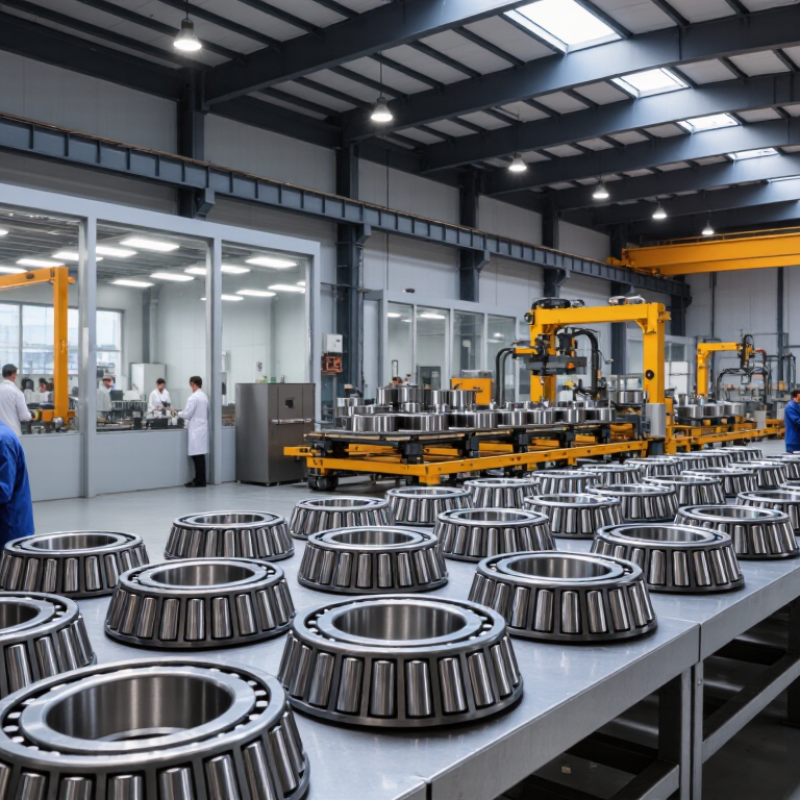
China’s tapered roller bearing manufacturers serve automotive, mining, construction, and industrial machinery markets. Leading producers usually offer metric and inch series, single-row and double-row designs, and matched bearing sets. Their product ranges may cover light-duty wheel hubs, heavy gearbox shafts, and large conveyor systems.
Accuracy classes deserve careful checking. Standard P0 is suitable for many general machines, while P6 and P5 support tighter running accuracy. P4 is used where speed, vibration, and heat control are critical. However, class labels alone are not enough. Buyers should review radial runout, axial runout, noise, hardness, and internal clearance data. A clean inspection room matters. So does consistent heat treatment. Production capacity also needs practical evidence, including forging lines, grinding equipment, automated assembly, and monthly output records. Large capacity does not always mean stable quality. This is easy to overlook.
Tips:
Request sample inspection reports, batch traceability, material certificates, and life-test results before approving regular orders. Check whether stated capacity matches delivery history. Confirm packaging for humid transport. A factory may provide excellent samples but weaker mass production. Keep that possibility in your review. Choose suppliers that explain deviations openly, maintain calibrated equipment, and support corrective action after field feedback.