How to Choose Miniature Ball Bearings for Your Needs?
Choosing the right Miniature Ball Bearings begins with the application, not the catalog.
A bearing supporting a dental handpiece faces different demands than one inside a small robotic joint. Speed, radial load, axial load, temperature, noise, contamination, and available space must be measured together. Grand View Research’s Bearing Market Size, Share & Trends Analysis Report, 2024–2030, identifies automation, medical equipment, and aerospace systems as important demand areas. These applications increasingly require compact bearings with consistent accuracy and low friction.
Small does not mean simple.
Industry guidance supports a disciplined selection process. ISO 281 provides methods for calculating bearing rating life, while ISO 15243 helps classify damage modes such as wear, fatigue, and corrosion. SKF technical literature also emphasizes lubrication, sealing, alignment, and operating conditions when evaluating bearing performance. These factors can change service life dramatically, even when the bearing dimensions appear correct.
In practical terms, record the shaft diameter, housing fit, target speed, expected load, and operating temperature before choosing a part. A sealed bearing may protect against dust, but its seal can increase torque. Stainless steel can improve corrosion resistance, yet it may not deliver the same load capacity as standard bearing steel. Ceramic hybrid options can reduce friction, although their higher price requires a clear performance reason.
There is no universal best choice.
Published data offers valuable direction, but real installations still need validation. Misalignment, poor lubrication, or an underestimated shock load can defeat an otherwise excellent specification. The most reliable decision combines standards, manufacturer data, prototype testing, and honest review of field conditions.
Define Bore, OD, and Width Using ISO 15 Bearing Dimension Standards
How to Choose Miniature Ball Bearings for Your Needs?
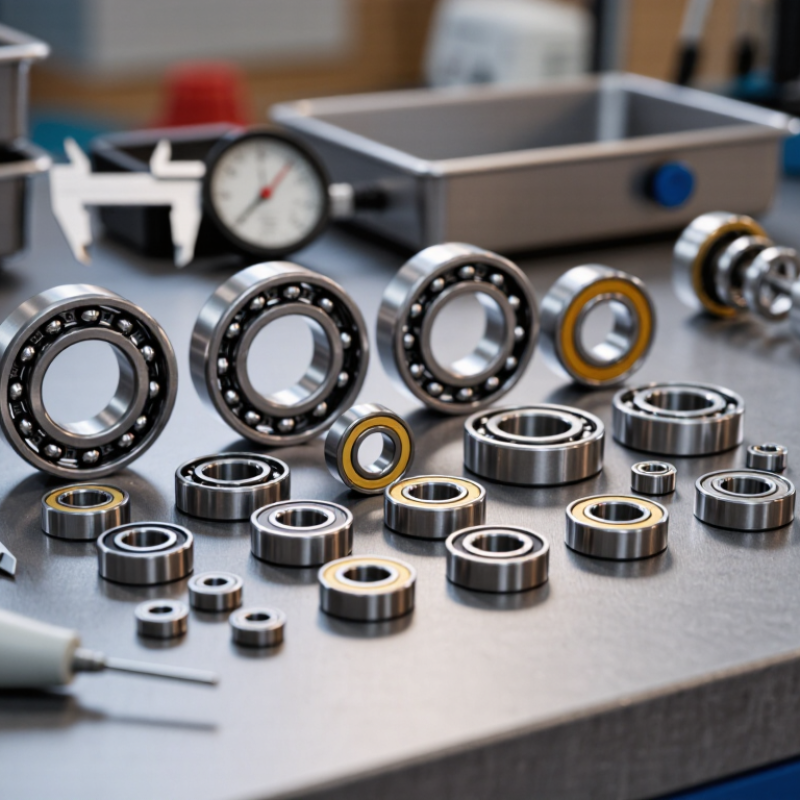
ISO 15:2017 defines key radial bearing boundary dimensions. The bore, or d, fits the shaft. The outside diameter, or D, fits the housing. Width, or B, controls the axial space. Measure in millimeters, not by appearance. A bearing marked 4 × 8 × 3 mm has a 4 mm bore, an 8 mm outside diameter, and 3 mm width. These numbers must match the shaft, housing, and available clearance.
Check the drawing carefully. ISO 15 supports dimensional interchangeability, but it does not select the correct load rating, seal, material, or internal clearance. A tight shaft fit can reduce running clearance. A loose housing fit can create creep and heat. Industry maintenance literature often links about 40% of rolling-bearing failures to lubrication problems, although estimates vary by application. Keep that uncertainty visible. The wrong grease can be as harmful as the wrong size.
Market demand also reinforces the need for accurate selection. Grand View Research estimated the global ball-bearing market above USD 16 billion in 2023. That scale makes dimensional control more than a catalog exercise. In practical checks, I remeasure the bore and housing after machining. I have seen small burrs change an apparently correct fit. Sometimes the drawing is incomplete. Ask for tolerance, speed, load, temperature, and sealing requirements before ordering. One dimension rarely tells the whole story.
How to Choose Miniature Ball Bearings for Your Needs? - Define Bore, OD, and Width Using ISO 15 Bearing Dimension Standards
Use the ISO 15 boundary dimensions below to compare miniature and small deep-groove ball bearings. All dimensions are in millimetres.
| Generic Bearing Designation |
Bore, d
(mm) |
Outside Diameter, D
(mm) |
Width, B
(mm) |
Dimensional Selection Note |
| 625 |
5 |
16 |
5 |
Compact option for a 5 mm shaft and limited radial space. |
| 626 |
6 |
19 |
6 |
Suitable when a 6 mm shaft and a narrow bearing width are required. |
| 627 |
7 |
22 |
7 |
Provides a 7 mm bore with a moderate outside diameter. |
| 628 |
8 |
24 |
8 |
Balanced choice for an 8 mm shaft where radial space is restricted. |
| 629 |
9 |
26 |
8 |
Offers a 9 mm bore while maintaining an 8 mm bearing width. |
| 608 |
8 |
22 |
7 |
Small outside diameter for applications requiring an 8 mm bore and reduced radial envelope. |
| 6000 |
10 |
26 |
8 |
Common compact size for a 10 mm shaft and an 8 mm axial width. |
| 6001 |
12 |
28 |
8 |
Maintains a narrow 8 mm width with a 12 mm bore. |
| 6002 |
15 |
32 |
9 |
Useful when the shaft diameter increases but axial space remains limited. |
| 6003 |
17 |
35 |
10 |
Provides a 17 mm bore with a moderate 10 mm width. |
| 6004 |
20 |
42 |
12 |
Suitable for a 20 mm shaft where additional radial capacity may be needed. |
| 6005 |
25 |
47 |
12 |
Larger bore size for assemblies with greater shaft diameter and housing space. |
How to read the dimensions:
Bore (d) is the nominal shaft diameter, outside diameter (D) is the required housing or radial envelope, and width (B) is the axial space occupied by the bearing. ISO 15 defines standardized boundary dimensions; load, speed, sealing, clearance, material, and fit requirements should also be checked before final selection.
Match Radial Loads to C and P with the L10 = (C/P)³ Life Model
Choosing miniature ball bearings begins with matching the applied radial load to the bearing’s dynamic load rating. The key relationship is
L10 = (C/P)3
Here, C is the basic dynamic load rating, while P is the equivalent dynamic load. Both values must use the same units.
Suppose a bearing has a C rating of 120 N and carries a steady radial load of 30 N. Its calculated L10 life is 64 million revolutions. If the load rises to 60 N, life drops to 8 million revolutions.
The load doubled, but the predicted life fell eightfold. Small errors matter.
Measure the load carefully. Avoid guessing from motor size alone. In real assemblies, shaft misalignment, belt tension, shock, contamination, and preload can increase P. A bearing operating near its limit may also generate more heat than expected.
L10 is not a guaranteed service life; it predicts the point where 10% of identical bearings may show fatigue, under defined conditions. Lubrication and speed still require separate checks.
For combined radial and axial forces, calculate the equivalent dynamic load instead of using radial force alone. This model is useful, but imperfect. Real machines rarely behave like laboratory test rigs.
Select ABEC Precision Classes and ISO P0–P4 Runout Requirements
How to Choose Miniature Ball Bearings for Your Needs?
Choosing a miniature ball bearing starts with the required precision, not the highest available rating. ABEC classes describe dimensional and geometric accuracy. Higher classes can reduce variation, but they do not automatically guarantee lower noise or longer service life. A small inspection spindle may need ABEC 5 or 7, while a light-duty instrument may perform reliably with ABEC 1 or 3. Check the shaft fit, housing tolerance, speed, load, and operating temperature together.
ISO P0–P4 runout requirements focus on rotational accuracy. P0 is suitable for many general mechanisms. P1, P2, P3, and P4 indicate progressively tighter control where the specification uses these grades. However, ISO bearing precision designations are not always listed in a simple P0–P4 sequence. Confirm the supplier’s exact standard and test method. Radial runout affects the shaft’s orbit, while axial runout changes end-face movement. That difference matters.
Measure the assembled system, not only the bearing. A precision bearing can still run inaccurately inside a rough or misaligned housing. For example, a miniature camera stage may show image drift if the shaft seat is uneven. In practice, I would select the lowest grade that meets the measured requirement. Over-specification increases cost and may reveal weaknesses elsewhere. This is easy to overlook.
Clearance
Lubrication
Contamination
Mounting force
also influence real-world accuracy. Record runout at operating speed when possible, because static results can be misleading.
Set Speed, Lubrication, and Temperature Limits for 440C Steel Bearings
How to Choose Miniature Ball Bearings for Your Needs?
For 440C stainless steel bearings, speed, lubrication, and temperature must be evaluated together. A miniature bearing running at 30,000 rpm may generate significant frictional heat. ISO 15312:2018 defines reference speed, but it is not a guaranteed operating limit. Cage design, radial load, clearance, and mounting accuracy can reduce that value. I usually begin with the DN value, calculated from bore diameter and rotational speed. Many miniature applications fall near 100,000–300,000 DN, but this range is only a screening guide. ISO 281:2007 also warns that calculated life cannot replace thermal and lubrication checks.
Tips: Choose the lubricant before finalizing the bearing. Light synthetic oil can support higher speeds than heavy grease, while grease usually simplifies maintenance. Confirm the lubricant’s viscosity, base oil, and temperature range. A 440C ring may tolerate temperatures above 200°C, yet the grease, cage, seals, and heat treatment may fail much earlier. In practice, continuous operation near 120°C deserves careful validation. Short peaks are different from constant heat.
Measure the outer-ring temperature during a realistic load test. Keep speed increases gradual. Watch vibration and rising torque. These signs often appear before visible damage. Industry test guidance recommends recording speed, load, ambient temperature, and lubricant quantity together. That data makes ISO-based life estimates more credible. Still, my first selection is rarely perfect. Contamination, excessive preload, or too much grease can overturn laboratory assumptions. A modest safety margin is usually wiser than chasing the catalog’s highest speed.
Choose Seals and Materials for Corrosion, Dust, and Operating Conditions
How to Choose Miniature Ball Bearings for Your Needs?
Seal selection starts with the contamination, not the catalog size. Open bearings suit clean housings and frequent relubrication. Shielded bearings reduce dust entry with low friction. Contact seals provide stronger protection against water and fine particles, but they increase starting torque and heat. In a compact mechanism, that trade-off can matter more than expected.
The NACE IMPACT study estimated global corrosion costs at US$2.5 trillion annually, equal to about 3.4% of global GDP. This figure supports careful material selection near humidity, salt spray, or cleaning fluids. Standard stainless steel offers useful corrosion resistance for many light-duty applications. High-carbon chromium steel usually provides higher hardness and fatigue performance. Ceramic rolling elements can reduce electrical damage and friction, but their cost and installation demands require justification.
Operating temperature changes the decision again. Standard elastomer seals may harden, swell, or lose contact under heat and chemicals. Fluorinated sealing materials often tolerate harsher conditions, though compatibility must be checked against the actual fluid. ISO 9223 helps classify atmospheric corrosivity, while ASTM B117 salt-spray testing can compare protective performance. These tests are useful, but they do not perfectly reproduce field exposure. I would not trust a seal rating alone. Check shaft finish, housing fit, speed, grease behavior, and real dust size. Small oversights cause large failures.
Typical Continuous Temperature Ranges for Miniature Bearing Seal Materials
Use NBR for economical protection against dust and general oil exposure, FKM for higher temperatures and many aggressive chemicals, silicone for very low-temperature flexibility, and PTFE where broad chemical resistance and extreme temperature capability are required. The ranges shown are typical reference values; the final choice should also consider moisture, dust level, speed, lubricant compatibility, and the bearing manufacturer's design limits.